
Discover clarity about your diet: this detailed review explores my personal journey with the EverlyWell Food Sensitivity Test, examining IgG inflammatory responses to 96 common foods. This post is proudly sponsored by EverlyWell. Unlock your insights today with code BAKERITA for 15% off!
Unlocking Dietary Clarity: A Deep Dive into My EverlyWell Food Sensitivity Test Experience
If you’re a regular visitor to my blog, it’s likely you or someone in your family navigates the world with specific dietary considerations. This quest for healthier eating and baking is precisely what led me down this path. My journey began years ago, primarily driven by shared family dietary restrictions. Both my sister and my father, much like myself, adhere to a gluten-free diet. Additionally, my father and I have found immense relief by eliminating dairy. For each of us, these dietary adjustments weren’t arbitrary; they were born from years of trial-and-error, careful observation, and often, challenging elimination diets to understand how certain foods impacted our well-being.
While I’ve long possessed an intuitive understanding of which foods my body doesn’t tolerate well, these insights were always based on personal experience rather than scientific validation. The absence of a concrete lab test to confirm my suspicions often left me wishing for a clearer picture. This desire for definitive answers is why, when I first encountered EverlyWell on Shark Tank, my interest was immediately piqued. EverlyWell distinguishes itself as a pioneering company offering convenient, at-home, lab-tested health solutions across a vast spectrum of health categories. Among their comprehensive suite of tests, the food sensitivity test stood out as particularly relevant to my personal health journey.

Why Choose EverlyWell for Food Sensitivity Testing?
The allure of the EverlyWell Food Sensitivity Test was undeniable. I was incredibly curious to scientifically pinpoint which foods might be contributing to adverse reactions in my body. Beyond food sensitivities, EverlyWell’s extensive product catalog addresses numerous health concerns, including tests for thyroid function, metabolism, heart health, STD screenings, and comprehensive men’s and women’s health panels. You can explore their full range of offerings on their products page. What truly sets EverlyWell apart is the unparalleled convenience it offers. Each test kit is delivered directly to your doorstep, allowing you to collect your sample at your absolute convenience, without the need for doctor’s appointments or clinic visits. Once collected, you simply mail the sample back, and your confidential results are typically available within five business days. This streamlined process dramatically simplifies the often cumbersome traditional medical testing experience, making health insights more accessible than ever before.
Understanding the Science: IgG Immune Response
Let’s delve deeper into the specifics of the Food Sensitivity Test I undertook. This particular test is designed to measure your body’s immunoglobulin G (IgG) immune response to 96 commonly consumed foods. It’s crucial to understand the role of IgG antibodies. These antibodies are an integral part of your immune system, providing long-term resistance to infections and acting as a natural defense mechanism against what your body might perceive as “food allergens” or “pathogens.” However, it’s important to distinguish food sensitivities from immediate food allergies. While IgG antibodies indicate a delayed immune response often associated with sensitivities, they are only one type of antibody. Immediate, life-threatening food allergies, for instance, are typically mediated by IgE antibodies, which react very differently in the body. Therefore, while the EverlyWell Food Sensitivity Test is an excellent tool for identifying potential sensitivities, it doesn’t cover every possible type of food reaction or allergy.

Your test results are meticulously categorized, revealing the reactivity levels of your IgG antibodies to each of the 96 foods commonly found in Western diets. The classification system is straightforward: Class 0 signifies no reactivity, while Class 3 indicates a high level of reactivity. While this test doesn’t encompass every single food known to man, it provides a remarkably insightful starting point for identifying potential dietary triggers that may be contributing to chronic inflammation, digestive issues, or other discomforts. This targeted approach empowers you with actionable information to begin refining your diet and improving your overall well-being.
The Effortless EverlyWell Testing Process
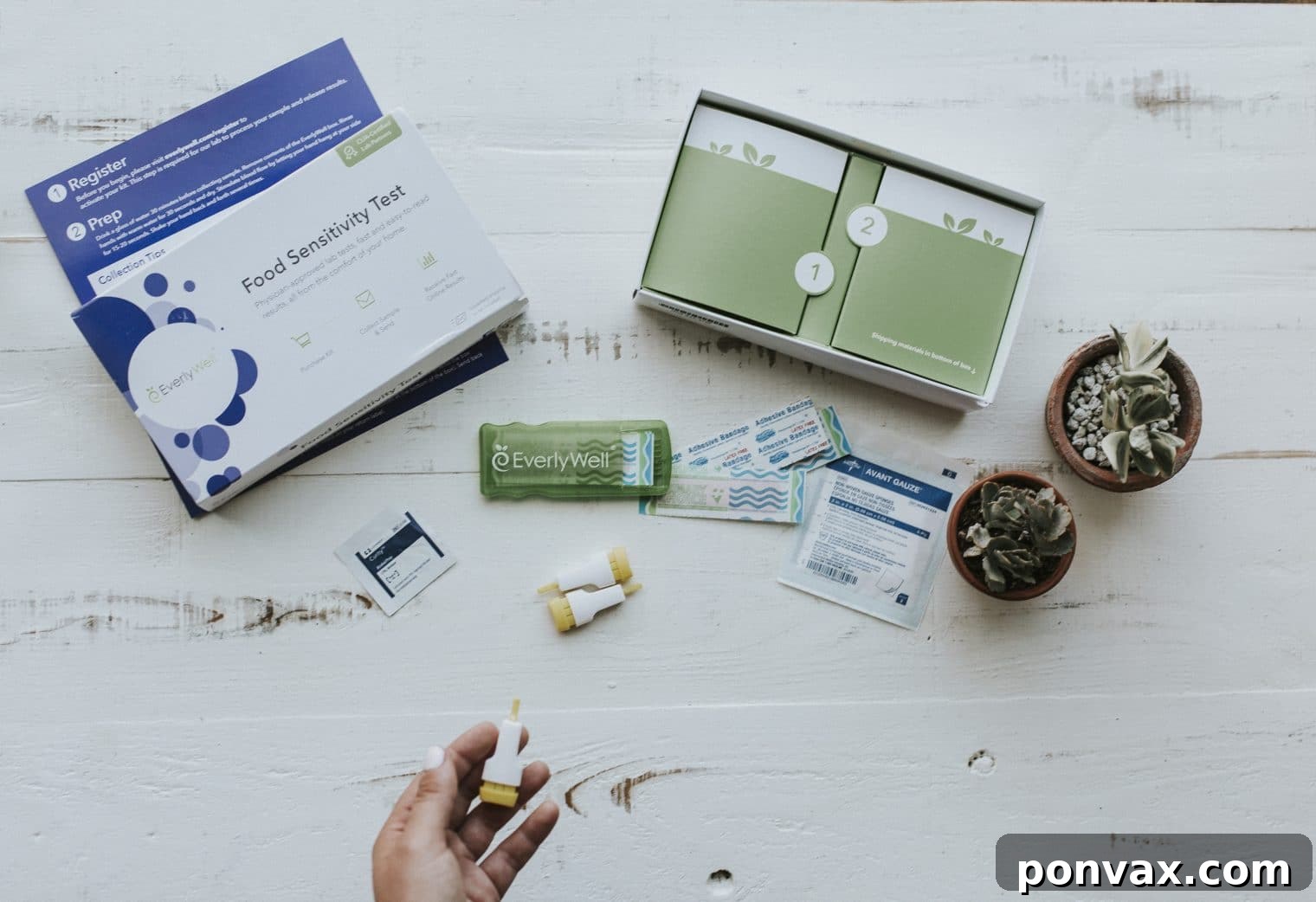
From the moment the EverlyWell kit arrives, the entire testing process is designed for maximum simplicity. The kit includes clear, step-by-step instructions that make sample collection incredibly straightforward. Inside, you’ll find everything needed for a quick and sanitary blood sample: a small finger-pricking device to painlessly obtain a few drops of blood, a specialized collection card for your blood samples, a biohazard bag for secure return, along with sterile gauze, band-aids, and an alcohol pad to prepare your finger.

The actual sample collection couldn’t be easier. A few minutes before starting, it’s recommended to drink some water and gently shake your hand to promote blood flow. After sterilizing your chosen finger with the alcohol pad, you simply use the small, spring-loaded lancet to give yourself a quick poke. I can honestly say I found the discomfort to be minimal, far less than what one might expect. The goal is to collect five distinct drops of blood onto the designated circles on the provided card. Once collected, allow the blood to air dry completely, then place the card into the biohazard bag, and pop it into the pre-paid return envelope. This entire process takes mere minutes and is significantly more convenient and less intimidating than a traditional visit to a lab or doctor’s office for blood work.
For those who might be squeamish about blood, rest assured the process is very clean and contained. My friend and photographer, Tiffany, who helped capture these images, isn’t a fan of blood, yet she found the experience entirely manageable. It’s truly just a couple of small drops, and then you’re quickly bandaged up – no mess, no fuss.

Receiving and Interpreting Your Personalized Results
Approximately five days after mailing your sample, an eagerly anticipated email will land in your inbox, containing a link to your personalized test results. The results are presented in a remarkably clear and user-friendly format, typically an intuitive online dashboard that allows you to easily view your sensitivities categorized by reactivity level. In my case, while I didn’t have any severe sensitivities (Class 3), I did discover 13 mild sensitivities (Class 1 or 2), with the remaining 83 foods showing very low reactivity (Class 0).
What I found most validating was how well my test results aligned with my long-standing intuitive understanding of my body. Many of the foods flagged as mild sensitivities were items I had already consciously minimized or eliminated from my diet: cheddar cheese, cow’s milk, mozzarella, gluten, cottage cheese, wheat, and even coffee (though I confess a weakness for my mushroom coffee!). However, the test also delivered a few surprising insights. Foods like sunflower seeds, pineapple (a true heartbreak!), bran, scallops, codfish, and grapes appeared on my list of mild sensitivities. The grape sensitivity initially puzzled me, but then a realization dawned: for years, consuming wine had consistently triggered severe headaches. Suddenly, the grape sensitivity made perfect sense, providing a concrete explanation for a persistent, unexplained issue.

Beyond simply listing reactive foods, EverlyWell provides invaluable resources. You receive a personalized PDF report (with an additional version tailored for your healthcare provider) brimming with detailed information about each tested food and its specific reactivity level for you. This comprehensive report also includes an important caveat: if you’ve eliminated a food from your diet for an extended period (typically over a month), your body may not produce a high level of IgG antibodies against it, potentially leading to a lower reactivity score than if you were actively consuming it. This is because the immune response naturally wanes when the “pathogen” is absent.
Given that I had already cut out milk, cheese, and gluten from my diet long before taking the test, it’s entirely plausible that my body’s true sensitivity to these items is higher than what the test indicated. The reduced antibody count simply reflects the lack of recent exposure. Conversely, if your diet includes a wide variety of foods, the test results will likely provide an accurate snapshot of your current IgG reactivity levels. It’s also crucial to remember that while the EverlyWell test evaluates 96 common foods, the world contains thousands upon thousands of different ingredients. Therefore, this test serves as an excellent starting point and a powerful educational tool, but it’s not an exhaustive assessment of every single possible food sensitivity. It equips you with vital information to begin making informed dietary choices and opens the door for further exploration if needed.

Empowering Your Health Journey with EverlyWell
My experience with the EverlyWell Food Sensitivity Test was overwhelmingly positive. It provided the scientific confirmation I had sought for years, validating my dietary suspicions and offering tangible insights into how my body interacts with various foods. The convenience, clarity of results, and comprehensive reports make it an invaluable tool for anyone looking to gain a deeper understanding of their health. It empowers individuals to take proactive steps towards managing their diet and improving their overall well-being from the comfort of their own home. I sincerely hope this detailed review has addressed many of your questions about EverlyWell and its food sensitivity testing capabilities. Should you have any additional inquiries, please don’t hesitate to share them in the comments section below, and I will do my utmost to provide comprehensive answers promptly.
Ready to embark on your own journey to dietary clarity? Whether you’re interested in the Food Sensitivity Test or any of EverlyWell’s other cutting-edge health tests, you can use the exclusive code BAKERITA for a fantastic 15% OFF your order!

References and Further Reading
- EverlyWell Food Sensitivity Test Product Page
- The Whole Journey: Differences Between IgE and IgG Testing for Allergies and Sensitivities
- National Center for Biotechnology Information: The role of IgG antibodies in the pathogenesis of food allergy